
Blogs / Property Management System
Choosing a Hotel PMS? 8 Advanced Features You Can’t Ignore in 2026
Choosing a Hotel PMS? 8 Advanced Features You Can’t Ignore in 2026


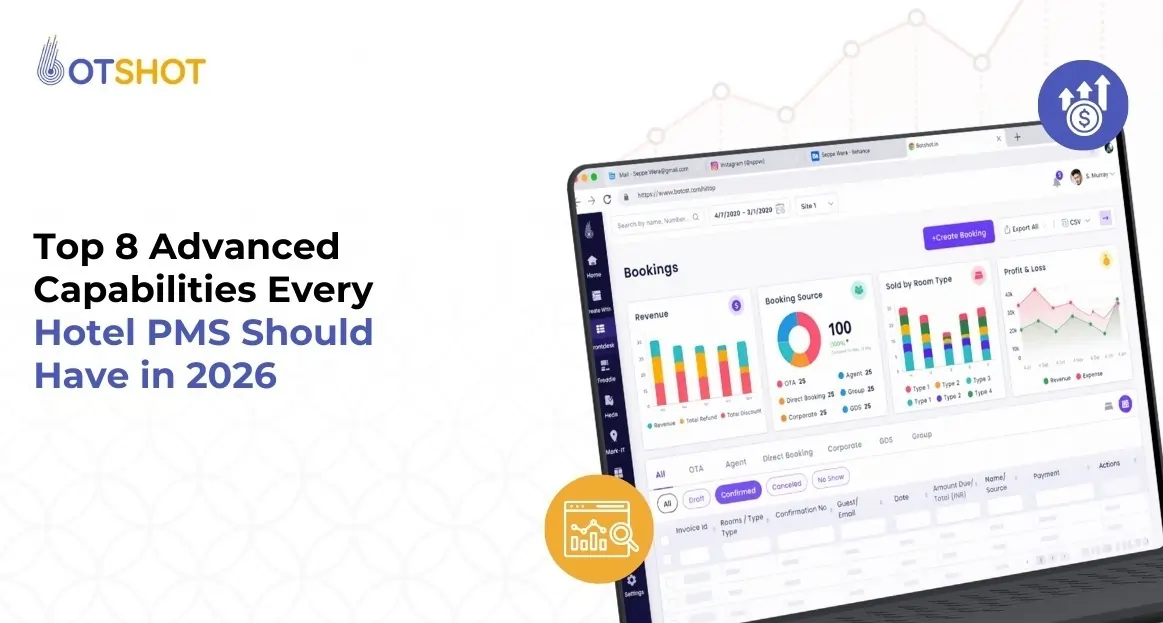
Whetheryou'rerunning a 2-star, 3-star, or 5-star property, there are plenty of PMS options available from BOTSHOT for mid-scale hotels to Opera for luxury chains.
But at the end of the day, choosing the right hotel management software comes down to one thing: features that truly matter.
You might already have a PMS that helps you manage reservations from your desk and that's great. Butdoes it offer youa seamless 360° guest experience?
But after talking to 100+ hoteliers to date, we realize they no longer need a booking system; they want a connected ecosystem that delivers efficiency, insight, and an exceptional guest experience.
Because when your PMS lacks the right features or integration capabilities,you'l lend up spending morein the long run.
If your answer is “not yet", then now is the perfect time to upgrade to an advanced PMS — one that ensures you don't leave any money or guest satisfaction on the table.
Let'sdiscuss in detail the top 8 must-have features that your PMS should have in 2026 and beyond:
Top 8 Features that every GREAT PMS should have in 2026and beyond
In today's world, a good PMS goes beyond bookings. It should enable features like WhatsApp notifications, sentiment analysis, and contactless check-in/check-out to provide a carpet like experience to guests.
On the backend, it should also handle petty cash management and E-invoicing, and can sync with your accounting tools, such as Tally, to automate operations effortlessly.
Ultimately, the right PMS depends on your property size, available workforce, and the level of convenience you want to offer your guests. Choose wisely, because the right system can transform not just your operations but your entire brand experience.
1. Room Inventory Management
A property management system is basically an all-in-one software to help hoteliers manage everything from reservations to check-out. The PMS you upgrade to today should support 2-way connectivity with the channel manager.

This means whatever inventory you update on the PMS is also updated across other channels, including OTAs and Global Distribution Systems.
But what if the PMS you invested in isn't integrated with a channel manager? Then you won'tbe able to become more visible to potential travelers.

2-way syncing between the channel manager and PMS is important for hoteliers because of the following reasons:
- You can track your hotel inventory at your fingertips – how many rooms are available, how many are occupied, and through what sources bookings were made.
- Manually updating room inventory is time-consuming – updating availability and pricing information across different channels may take significant time.
You need to log in to different OTAs each time, and such back-and-forth hassle isn't just time-consuming; it costs you more than that.
That's why such 2-way integration ensures that whatever information you update on the PMS is synchronized across other distribution channels.

Result: Transparency in room bookings and prices
There will be no lost revenue because a single dashboard shows you the status of available and sold-out rooms. If there's room availability, you can take the bookings and recover that lost revenue.
2. Petty Cash Management

Every hotelier keeps a record of petty cash transactions to see where the cash flow is coming from and where it's going.
However, manually recording of cash inflows and outflows is a time-consuming task.
That’s why it’s important to choose hotel management software that automatically record the small, everyday petty expenses such as office supplies, last-minute guest amenities, or minor repair and maintenance costs.
An efficient PMS should also generate profit and loss reports, helping you analyse spending patterns and maintain better financial control across departments.
3. Sentiment Analysis
For any hotelier, guest experience matters the most. If you don't understand your guests' sentiments, such gaps will be reflected in your revenue.
That's why you need a PMS that can be integrated with a feedback management software to keep track of guest sentiments like what they feel and how they feel when they arrive at your property.
You might ask: how is the feedback process automated?
When a guest arrives at the property, you can send customized feedback forms, including in-stay and post-stay surveys, to them.
Once you get insights about customers such as their preferences, which amenities they like the most, and their sentiments. You can serve them better while they treat the property.
Through sentiment analysis, the system can categorize positive and negative feedback, and if there are negative reviews, the ticket will be escalated to the right department.

By getting valuable insights about guests, you can enhance their experience, see what factors affect their stay, resolve their queries, and let guests leave the hotel with a smile.
4. Hotel Complaint Management
If your hotel doesn't take guest complaints seriously, it's likely to cost you money and damage your brand reputation.
In fact, a dissatisfied customer is likely to spread negative word of mouth and share their experience with at least 9-15 other customers.
As soon as a complaint arises, you need a compliant management software that records the complaint automatically and escalates it to the right staff so the complaint can be resolved quickly.

But most PMS solution providers lack such features, so integrations need to be made.That's where BOTSHOT can help you integrate a complaint management system with your existing PMS so that you can view guest complaints and issues on a single platform.

Note: This can bebecome a BIG challenge, especially when you have limited housekeeping staff, more rooms, and more guests to serve, and you risk missing their complaints.
5. WhatsApp Integration
Once a guest makes a reservation, you need a channel to notify them about pre-check-in, check-in messages, reservation details, etc.
As 3 billion customers use WhatsApp daily, staying in touch with guests becomes difficult, and that's why using WhatsApp marketing software is an easy way to market your hotel.
This not only frees up your front desk staff from sending booking confirmations, but it also creates an opportunity for you to automate marketing messages and other upsell or cross-sell offers.
Though traditional PMS systems don't support such integrations with WhatsApp, such integration cannowbe done easily by upgrading to cloud-based PMS that support such integrations.
6. POS Integration
In the hospitality industry, multiple departments handle day-to-day finance-related transactions, such as bookings, revenue, and expenses like purchasing supplies or the percentage of commission OTAs charge on each booking.

For that, you need to keep a record of accounting transactions and GST compliance through one platform.
That's why we provide such technology integrations like integrating your current accounting system (such as Tally) with PMS to generate automated invoices and update them on government websites.
7. Payment Rules
The next feature that a property management system should offer is flexible payment options for guests, such as credit cards, debit cards, or secure payment gateways like Razorpay.

This way, hoteliers can reach international guests by offering diverse payment options, giving guests a seamless payment experience.
Modern PMS systems also allow hoteliers and resort owners to set advance payment rules, such as requiring 30% of the booking amount at the time of reservation, while the rest can be paid before check-in.

Through this advance payment rule functionality, hoteliers reduce no-shows by collecting advance payments upfront and ensure steady cash flow for the property.
Guests receive automated payment reminders from the hotel, ensuring they don't miss payment deadlines.
Additionally, guests can split bills using different payment methods, whichever suits their preferences, or even split the invoice among themselves. The PMS can also block payments for a certain period, which is helpful when dealing with refunds or cancellations.
8. Staff Management and Its Role
While a standard PMS is related to making reservations, an advanced PMS brings staff activities, their schedules, and tasks onto one platform.
But you might ask: what makes a modern PMS different from standard PMS functionalities? An advanced PMS contains a staff roster feature that lets you see who is working and when they're working.
Let's say you have a 100-room property with around 30+ housekeepers, but you won't be able to track each one of them, especially when the property is crowded with guests.
PMS with advanced functionalities keeps an eye on staff availability and their shift timings, and if an employee is unavailable during their shift, it sends an alert automatically to the right department.
But does it assign tasks to the staff?
Yes, it assigns tasks automatically to the right staff. For example, if room 101 needs cleaning, it will assign the task to the right housekeeping staff member who is available that day, and if the task remains unresolved, it raises an alert to their manager.
How BOTSHOT Can Help You Manage Your Hotel Operations with Advanced PMS?
You can find many good cloud-based PMS options at affordable prices, and all of them have some basic core functionalities that make managing daily operations and revenue easy.
These include personalize guest experience, managing and tracking reservations, and generating reports through a single platform.
But not every hotel management software offers advanced functionalities meaning a 360-degree ecosystem where you can manage more than simply a reservation system.
Modern cloud-based PMS can take on different roles. Sometimes it can manage guests' data; other times, it can become a POS for the F&B division and can be used to give your guests great service.
No matter if you're running an independent property, owning a small hotel, or running a large hotel chain, we know that PMS switches are no longer a nightmare.
That's why our BOTSHOT team is open to integrations with existing systems, helping you get a better ROI for your property that would otherwise not be possible with on-premises or off-the-shelf software.
Sign up for our 14-day free trial to make your hotel PMS a truly 360-degree experience.


Gurpreet Kaur
| Sr. Technical Writer
Gurpreet Kaur is a content writer with firsthand experience in guest relations and hospitality service design. Her time in the hotel industry gives her a deep understanding of guest expectations, which she channels into content that promotes technology as a tool for better experiences. Gurpreet specializes in writing about contactless solutions, smart room technologies, and sustainable hospitality practices.