
Blogs / Hotel Pricing
OTA vs Direct Bookings: What Drives Higher Hotel Revenue in 2026?
OTA vs Direct Bookings: What Drives Higher Hotel Revenue in 2026?


If you're like most hoteliers, you're spending too much time analyzing whether you should list your hotel on an OTA or instead create a website. The right choice depends on various factors such as the size of your hotel, your marketing budget, and how strong your online presence is.
After talking to 100+ hoteliers, we know that some have generated business by choosing OTAs as their distribution channel, but that too at the cost of high commission charges.
But after a certain point, they realize over-reliance on them reduces their gross operating profit, and hence they should create a balance between the two.
Let's read this blog to find out how OTA bookings are different from direct hotel bookings and which one you should choose in 2026.
What is an OTA in the hotel industry?
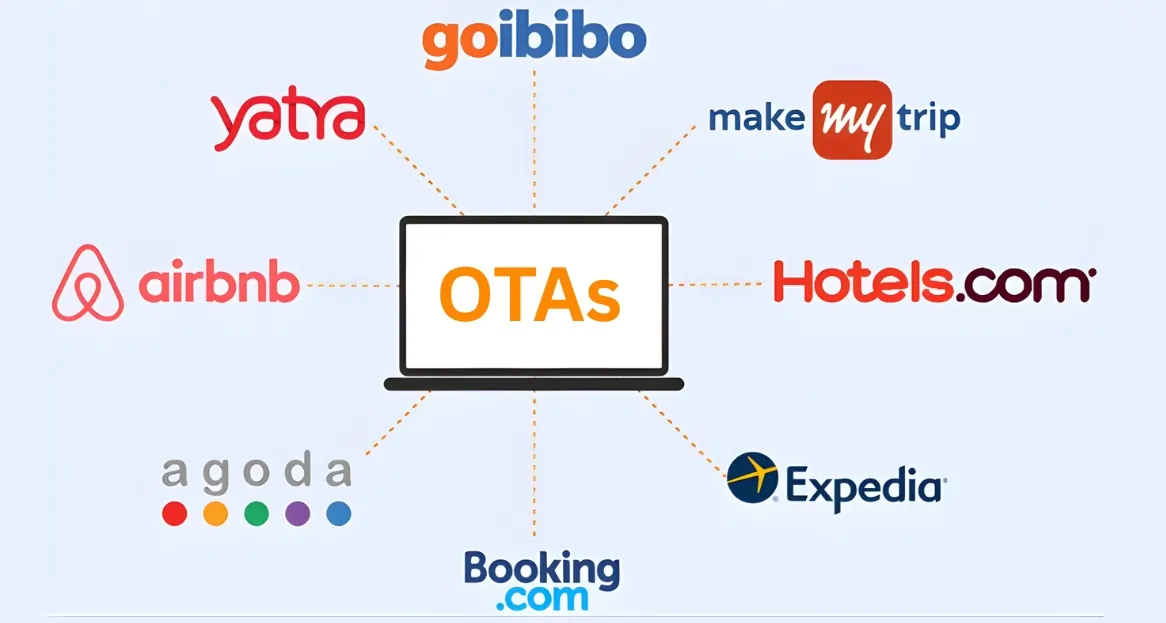
OTA stands for online travel agency which is basically a platform where travelers can find travel packages, flight tickets, hotel bookings, and rentals at one place.
Consider Online travel agencies as a marketplace where they can compare different hotel options, see their prices, ratings, and read reviews on one platform in just 30 seconds.
Their goal is to find the hotel or plan a trip at the best possible price.
What makes OTA bookings different from direct bookings? OTAs don't sell their own products; rather, they sell the products of third parties. Some popular examples of OTAs include expedia.com, booking.com, and hotels.com.
While hoteliers can get massive exposure on the web as these online travel agents have significant traffic, that comes at the cost of high commission fees and lost customer data.
As per Skift Research in Hotel Distribution Outlook 2024, online travel agencies still hold the largest share for gross total bookings, and in 2019, they generated around $270 billion.
But it's expected that by 2030, hotel digital channels will surpass the dominance of OTAs in the travel industry.
What are hotel direct bookings?
Hotel bookings are made when travelers make a reservation on the hotel's website rather than using OTAs. In this case, all communication and booking details come straight from the hotel, not through a third-party platform
This would be a win for hoteliers as they can save on the commission charges that OTAs charge (15-20% of the total booking value). To get direct bookings on their site, hotel owners need to integrate their website with a booking engine.
This way, they can get rid of OTA dependency and have more control over their revenue.
With direct bookings come the marketing costs related to website development, marketing their hotel, or promoting their property across different channels, which would give them rewards in the long run.
For instance, once they receive a booking on their site, they can now personalize the guest experience, offer them upsells or cross-sells, and even build great guest relationships.
How are hotel direct bookings different from OTAs? (Side by Side Comparison)
Here's a quick summary of how hotel direct bookings differ from OTAs.
1. Reach
Both direct bookings and OTAs are considered effective online distribution channels for hotels to market their properties. However, they differ in terms of reach and control.
Listing your property on OTAs such as hotels.com gives you wider reach as it makes you visible to millions of travelers who are searching for accommodations. This visibility is instant, but it's borrowed.
Direct bookings, on the other hand, give you owned visibility. No matter if you run a boutique-sized hotel or a 5-star property, creating a hotel’s website will not only bring guests, but that visibility belongs entirely to you.
2. Commission Rate
Over-reliance on OTAs for every booking means you need to pay hefty commission rates (15-20%) on each booking received. This means for smaller or independent hotels, such high commission rates can eat up their profit margins.
Hence, direct bookings are more cost-effective than OTA bookings.
Ultimately, you can save a significant amount (20%) by driving direct bookings. However, you will need to invest in long-term assets such as a website, SEO, and a booking engine, which may add an indirect cost of about 3–5%
3. Price Wars Tend to Happen, Resulting in Brand Devaluation
Becoming overly reliant on OTA bookings means you will have no control over your pricing.
OTAs such as Agoda, MakeMyTrip, and booking.com decide room prices based on how competitors have set their prices. That's how bookings made through OTAs bring the concept of price disparity.
This means even if the hotel doesn't wish to lower its prices, it still has to comply with OTA policy changes.
Having no control over pricing means the hotel's brand value is compromised, making the hotel rooms seem like a "commodity" rather than "offering a unique experience."
4. Which one brings business?
If your hotel has a limited marketing budget and you want bookings from day 1, OTAs can become the growth engine for your business. Not only do they rank higher than hotel websites, but they bring business from audiences you can't reach alone.
This can be international travelers, customers who check a property 20 times before booking, or corporate travelers.
Thus, more bookings from OTAs = more visibility = more bookings again.
That's how the cycle runs.
5. Marketing Expenses
OTAs deliver bookings today, give you instant results, and don't demand any upfront investment (such as ads, CRM, SEO, content marketing) as in the case of hotel direct bookings.
But OTA commissions are solely success-based, meaning you pay commission only when the room is sold.
6. Upselling
A hotel's website is a MUST for upselling and cross selling your services. In the case of OTAs, upselling is not possible as you don't have access to guest data.
But when a guest makes a reservation through your hotel's website, you can push your offers or add-ons such as spa treatments, dining packages, or upgrades from basic to deluxe rooms.

This not only brings more revenue for your hospitality business, but guests feel more special.
7. Offers and Packages
Hoteliers should run attractive offers and discounts for guests who book directly through the website.
Once you have a hotel website handy, you get access to guest data, so it's best to run some exciting offers and discounts for existing customers, such as a 10% discount code for returning guests.
Best part? You can tailor these offers depending on the type of traveler and seasonality patterns. For example, if you're targeting family travelers, you could run a family weekend offer or customized festive season package on your website.
This way, the discount you give to your returning customers will be much less than the commission paid to OTAs.
To better understand your guest behavior like their preferences, likes, booking history, or dietary restrictions like you can send them pre-stay, during-stay, and post-stay surveys to learn more about them.
Later, this helps you run those offers or make services more personalized for them. You can even promote these offers through social media marketing strategies.
For example, if they want to grab this offer of 2 nights at ₹4,999, they can avail it by visiting your website.
In the case of OTAs, you don't have any control to run such packages or offers.
How OTA bookings benefit your hospitality business?
Here’s how OTA bookings can bring benefits for your hospitality business-
1. Instant Visibility and Free Marketing
Mostly, the growth of hospitality businesses depends on OTA platforms such as MakeMyTrip, Yatra, EaseMyTrip, booking.com, etc. This can become a growth driver if your hotel is new and you want to reach more audiences and get more bookings online.
Not only does it give you instant visibility, but it also saves your marketing costs of hiring more people for website creation, content marketing, and SEO.
Best part? You don't have to wait for months to get your website ranked on search engine results pages and expect bookings.
But when it comes to getting bookings through OTAs, they handle the marketing side of things and spend crores on digital marketing, SEO, ads, and brand-building activities.
Note: A single independent hotel doesn't have huge marketing budgets to run ads and take care of content marketing and SEO. They can still market in a smarter way and get discovered by travelers through the power of OTA bookings.
In 2024, OTA platforms alone got 1.8 billion hotel bookings, and that shows how they contribute positively to the growth of the travel industry.
Reviews, ratings, and attractive photos can do a better job of attracting travelers.
2. Customers trust OTAs
Customers trust online travel agencies because they're like a one-stop platform for exploring a wide range of travel products and hotel deals.
Best part?
OTAs come with features such as secure payment gateways, real-time booking confirmations to customers, clear cancellation policies, a great number of verified reviews from customers, guaranteed refund policies, and round-the-clock support to customers.
3. Gives peace of mind to hotels (but at a cost)
Though OTAs provide a space to hoteliers for getting massive visibility along with a steady stream of bookings, that comes with the cost of high commission fees up to 20%.
Today, customers treat OTAs as the single hub where they can find everything such as hotels, read reviews, find flights, and make bookings without leaving that platform. This makes OTAs even more popular.
And even the rule of marketing says to be where your customers are.
Ignoring the importance of this distribution channel means you're losing potential customers.
Note: Customers are more likely to remember the name of the OTA, not the hotel.
What benefits do hoteliers get from direct bookings not from OTAs?
Though online travel agents provide you various reasons to choose them over having an SEO-optimized website for your hotel business.
But there are more reasons that direct bookings can give you, especially when it comes to building relationships with guests and creating personalized experiences for them.
1. Positions your hotel as a BRAND, not a COMMODITY

David Anthony Scott, CEO of Green Door Hotel, says:
"People who book directly through a hotel's website plan their stay 102 days in advance. But OTA guests' book much later that's 41 days in advance."
And there lies the difference between YOU vs Commodity.
Let's say if someone is looking for a 3-bedroom in Austin, they found you on Google, they love your property such as the experiences you shared on your website, and they booked a stay with you.
Even if the price is lowest or highest, guests won't care about that.
But what if the guest is searching for "3 beds, pool, Austin" on an OTA?
Then they would see a bunch of alternatives, and maybe your listing comes at the top.
But because the price was too high, they decided to skip you because they got a better option. That's where your hotel is positioned as a commodity, not a brand.
With direct bookings, you give guests a reason to come back again because now your brand recall value has increased.
They know that when they think about your brand, they will value those relationships, not the transactions that happened between you (hotelier) and guests.
2. Control over customer's journey
Unlike OTA bookings, direct bookings give hoteliers an opportunity to control their customer's journey like they can send pre-arrival links, do upsells even before guests arrive at the hotel, or enroll them in loyalty programs.
This way, by accessing guest data, you can personalize their stay experience and make use of upselling and cross-selling techniques to generate more revenue for your business.
3. Don't need huge marketing spend
OTAs are spending $10 billion or even more than that on marketing every hotel on their platform.
Not every hotel owner can have such a massive marketing budget to compete with OTAs or luxury hotels (with huge marketing spend), they can still invest in a small marketing team to get their name out in the market.
You just need to have a content engine, a storytelling strategy, or create authentic content that no one can replicate.
This way, you can compete with big-sized hotels like 4- or 5-star property owners, and that's how, by leveraging content marketing, you can provide on-par experiences to guests.
Build a content machine – Get loud – Show your people
Result – That's how you will win = Get more online visibility = Increase your bookings = Increase your RevPAR
Whether to choose OTAs or direct bookings as a channel for maximizing hotel revenue?
There's no one-size-fits-all strategy, as relying on OTAs as a distribution channel solely will increase your online visibility and help you fill your occupancy.
But it would reduce your profit margins, and you won't maintain guest relationships as online travel agencies act as a bridge between hoteliers and guests. Ultimately, it's good for giving you international reach.
But a direct channel of bookings gives you high profitability, and you have higher chances of owning the guest.
It's not about choosing which is better (OTAs or direct bookings); it's about which can turn your property into a highly profitable business.
What to do?
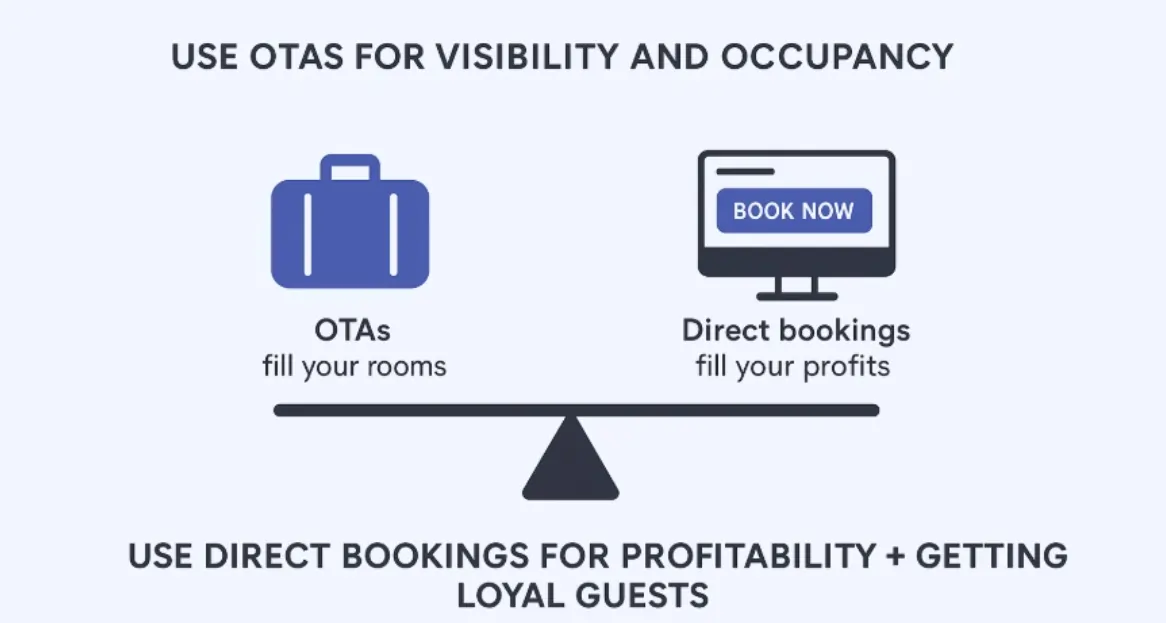
Create a balance between both:
- Use OTAs for visibility and occupancy
- Use direct bookings for profitability + getting loyal guests
(You need a website with a booking engine so that customers can click on the "book now" button).
Result:
- OTAs fill your rooms
- Direct bookings fill your profits
The other way is using the Pareto Principle for your hotel distribution channel strategy.
If you know that 80% of your guests, come from top 5 markets, then focus on getting direct bookings to generate 80% of that business and leave the remaining 20% to the OTAs.
How BOTSHOT can help you increase your direct bookings for your hospitality business?
If your hotel is listed on multiple OTAs, you need a channel manager to push the same rates and inventory information across different OTAs. That's how, through a single dashboard, you can manage multiple bookings for multiple OTAs.

This way, you can avoid overbooking challenges.
But if you're the owner of a 2- or 3-star property and you don't have an online presence beyond OTAs, you need to keep an SEO-friendly website handy.
For that, you don't need to own a big-sized marketing team. Using our BuildMySite with booking engine integration, you can build an SEO-optimized website even if you don't have technical knowledge.
You can run offers and packages on your website (long-stay discounts, festive offers). This way, you can attract travelers on the go, and they can book directly with you.


Gurpreet Kaur
| Sr. Technical Writer
Gurpreet Kaur is a content writer with firsthand experience in guest relations and hospitality service design. Her time in the hotel industry gives her a deep understanding of guest expectations, which she channels into content that promotes technology as a tool for better experiences. Gurpreet specializes in writing about contactless solutions, smart room technologies, and sustainable hospitality practices.